Cart
0
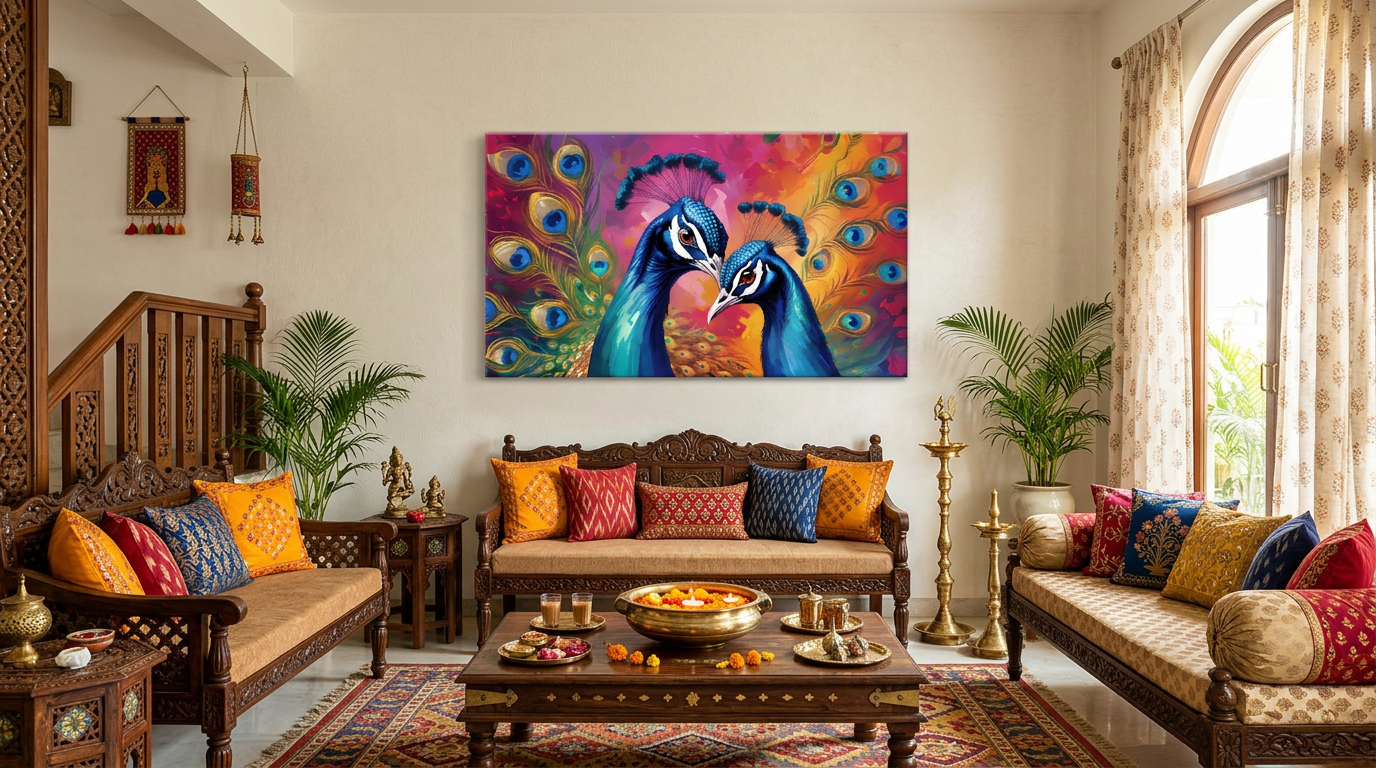
Few birds carry as much meaning in Indian homes as the peacock. Its colours, its open fan, and its place in art and tradition make a peacock painting a popular choice, whether it is a single bird with its feathers spread or a calm scene of a peacock in a landscape. The question most buyers ask is simple: which painting suits my room, and what does it say?
This guide looks at the peacock's place in Indian art and home decor, the different kinds of peacock paintings, how to choose one for your room, and what Vastu guidance commonly says. Symbolic meanings vary between families and sources, so the aim here is to help you choose with confidence rather than to set a single meaning for your home.
The peacock in Indian art
The peacock appears often in Indian art, from classical and folk painting to textiles and architecture. It is widely associated with beauty, grace, and confidence, and many people see it as a symbol of pride in oneself and in one's craft. Some traditions link it with the rains, since peacocks are often seen as the birds that dance when the monsoon arrives. Others connect the peacock with devotional imagery, and many families recognise its feathers as a reminder of calm and beauty.
Single peacock or a pair
The choice between a single bird and a pair often depends on the meaning you want the painting to carry. A single peacock with its fan open is commonly chosen for its sense of individuality and presence, and it suits a living room, a study, or an office where you want one strong focal point. A pair of peacocks is often associated with companionship and harmony, which makes it a popular choice for a shared living space or a gift for a couple. Both work well, as long as the composition feels balanced for the wall.
Calm peacock landscapes
Some peacock paintings are set in a landscape, with trees, water, and soft light around the bird. These pieces feel more restful than a single bird on a plain background, and they suit a bedroom or a reading corner. Look for a calm palette and open space, so the bird feels settled in its setting rather than crowded by detail.
Choose the colours with care
Peacock colours are rich, with deep blues, greens, and teals. Natural tones in these shades tend to feel calm and grounded, while very bright, saturated versions can feel intense in a small room. If your walls are light, a peacock painting with deep blues can add contrast. If your room is already dark, choose a version with lighter background tones so the piece does not feel heavy. Check how the colours look in both daylight and lamplight before you buy.
Match the size to the wall
A peacock painting usually has a strong vertical or fan-shaped form, so its size and shape matter. Aim for the piece to cover roughly two-thirds of the width of the sofa or console beneath it. Above a bed, use the same proportion with the headboard. Leave comfortable space at each side, and check the height with a paper template before you drill. A single bird with generous background space often looks more settled than a crowded composition.
Where it hangs best
In a living room, a peacock painting usually works well on the main wall behind the sofa, where it becomes a focal point for guests. In a study or office, a single bird on a side wall can add colour without distracting from work. In a bedroom, a calm peacock landscape above the bed suits rest. In a hallway, a slim vertical piece can welcome people as they arrive. Hang the centre of the painting around 57 to 60 inches from the floor, with the frame a few inches above any furniture below.
What Vastu guidance commonly says
Many people look to Vastu when they choose a peacock painting, and the guidance is not consistent. Vastu is a traditional practice rather than a scientific one, so treat the points below as traditional suggestions.
Several guides recommend the living room as the best place for a peacock painting. Some suggest the east or south-east wall, linking the bird with beauty and creativity, while others suggest the north-east for peace and growth. A number of guides suggest the west wall for a single bird with an open fan, associating it with gains and rain. Others place it on the north wall, particularly in a study or office. Some guides advise against bedrooms for lively or bold peacock imagery, and most suggest keeping caged or aggressive compositions out of the home.
Because the guidance differs, the most sensible approach is to choose the direction that fits your room and layout, and to follow the traditions that matter to your family. If direction is important to you, consult a practitioner you trust.
Practical checks before you buy
Check the listed dimensions, and whether they refer to the canvas or the frame. Look at the finish and the colour in close-up photos, since peacock colours can look very different on screen. Confirm the hanging hardware is rated for the weight, and read the delivery and damage terms. Peacock paintings often have fine detail, so a clear, sharp print or a carefully painted surface makes a real difference.
A simple checklist
- Decide whether a single bird or a pair suits the meaning and the room.
- Choose a calm landscape for a bedroom or reading corner.
- Pick natural, balanced colours, and check them in daylight and lamplight.
- Size the piece to about two-thirds of the furniture width, with generous background space.
- Hang the centre near 57 to 60 inches from the floor.
- Follow the Vastu tradition that matters to your family, and consult a practitioner if direction is important.
- Check the size, finish, hardware and delivery terms before you order.
A peacock painting can bring colour, grace and a sense of calm to almost any Indian home. Explore our paintings collection to find a peacock piece that suits your wall.