Cart
0
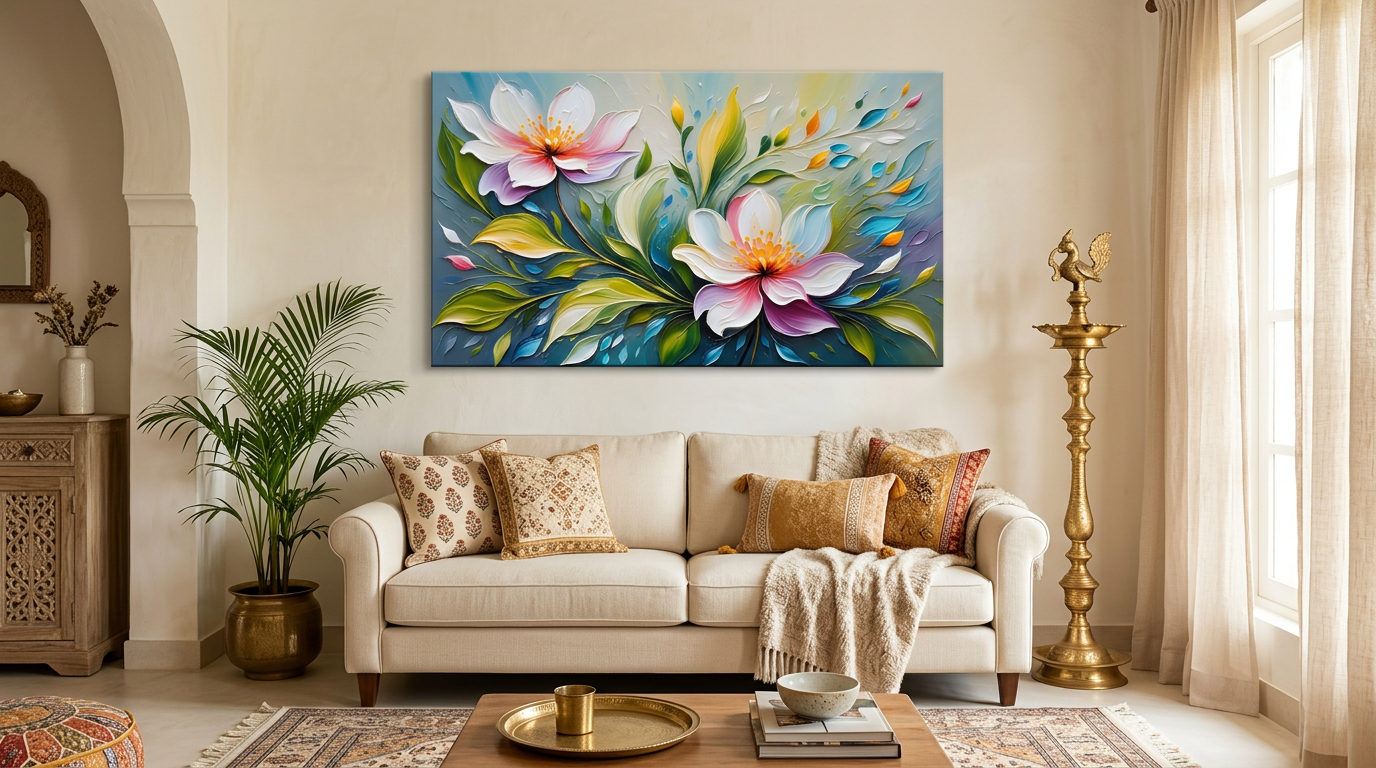
A canvas painting can transform a living room, and the sofa wall is usually where it has the most impact. The living room is where most Indian families spend their evenings, welcome guests, and gather for celebrations. Its walls set the tone for the whole home, and a canvas on the main wall can give the room a clear focal point. The challenge is choosing a piece that works with the sofa, the colours, the light, and the way your family uses the room day to day.
This guide walks through how to choose a canvas painting for your living room. It covers placement and size, colour matching, style, lighting, finish, and the practical checks to make before you order.
Choose the wall first
In most living rooms, the wall behind the sofa is the natural home for a large canvas. It is usually the first wall people see when they enter, and it gives the room a centre of attention. Before you look at any paintings, decide which wall will take the piece, and measure it. Note the width and height of the wall, and the position of doors, windows, switches, and shelves. A window in the middle of the wall may leave only two usable spaces, and a corner may not suit a large canvas at all.
Size the canvas to the sofa
The sofa is the anchor for the wall, so size the canvas to it. A common designer guideline is to aim for the canvas to cover roughly two-thirds of the sofa's width. A canvas much narrower than that can look lost above a large sofa, while one that spans the whole width can feel crowded against the corners of the room. Place the bottom of the frame a few inches above the sofa back, often somewhere between about 6 and 10 inches. Hang the centre of the canvas around 57 to 60 inches from the floor, close to average eye level, and check the result with a paper template before you drill. If your living room has tall ceilings, a larger, vertical canvas may suit the wall better. In a lower room, a wider, horizontal piece often feels more settled.
Match the palette to the room
Colour is one of the quickest ways to make a canvas feel part of the room. Look at the colours in your sofa, cushions, rug, curtains, and wood furniture, then choose a canvas that picks up one or two of them. You do not need an exact match. Warm tones such as ochre, terracotta, and muted green suit traditional interiors with wood and brass. Cooler tones such as soft blue, grey, and cream suit contemporary homes with clean lines. Neutral or soft backgrounds are generally the most flexible, since they work with changing cushions, rugs, and lamps over the years.
Choose a style that suits family life
Living rooms are used in many ways. Children may play on the floor, pets may rest on the sofa, and conversations may run late into the evening. Choose a canvas that suits the way you live, not only the way you would like to live. A lively scene, such as an open landscape or a running horse in warm light, suits a family room that is full of activity. A calmer composition suits a room used for quiet evenings. If you entertain often, a bold, confident piece can match the energy of guests.
Look at the light
A canvas can look quite different at different times of the day. Check the wall in morning sun, afternoon light, and evening lamplight, since each one shows the colours in a different way. A painting that looks bright at noon may feel dull after dark. Avoid placing a glossy canvas directly opposite a window, where reflections can make it hard to see. A matte finish is usually easier to live with in a room with a lot of daylight. A warm lamp placed near the canvas can bring out its richness in the evening without causing harsh glare.
Check the finish and the canvas
The finish changes how the painting looks and how it handles light. A matte finish reduces glare and suits bright living rooms. A satin finish sits between matte and gloss. A gloss finish can make colours look rich, but it reflects light, which can distract from the image in a busy room. Check whether the canvas is stretched tightly over a frame, and whether the edges are finished neatly. For a large canvas on the main wall, the quality of the stretching and the edge finish matters more than it does for a small piece.
Consider a frame or a gallery wrap
A gallery-wrapped canvas has the image continuing around the sides of the frame, which gives a clean, modern look without a separate frame. A floating frame sits slightly away from the canvas and adds a more finished edge. A gallery wrap often suits a contemporary room, while a floating frame can feel more traditional. If a frame is included, check its finish and whether it matches the furniture and the other metal or wood tones in the room. Include the frame in your weight calculations, since a large framed canvas can be heavier than it looks.
Think about the hanging
Check that the hanging hardware is included, and that it suits the weight of the canvas and the type of wall you have. A large canvas needs stronger fixings than a small one, and plasterboard and brick need different anchors. Use a paper template taped to the wall for a day or two before you drill. Step back and look at it from the sofa, the doorway, and the places where people usually stand.
Read the listing carefully
When you buy online, the listing is your main source of information. Confirm the exact dimensions, and whether they refer to the canvas or the frame. Look at several photos, including close-ups that show the surface and texture, and at least one photo of the piece in a room, so you can judge the scale. Check the delivery and packaging terms. A large canvas needs careful packing, and some sellers charge extra for larger or framed pieces. Read the return and damage policy, and keep the packaging until you have inspected the piece.
A simple checklist for the living room
- Choose the wall behind the sofa, unless the room suggests a better focal point.
- Aim for the canvas to cover about two-thirds of the sofa's width.
- Place the frame roughly 6 to 10 inches above the sofa, with the centre near 57 to 60 inches from the floor.
- Pick one or two colours from the room, and prefer soft backgrounds for flexibility.
- Choose a style that suits the way your family uses the room.
- Check the painting in morning and evening light.
- Choose a matte or satin finish if the room is bright.
- Confirm the size, the canvas and frame details, the hardware and the delivery terms.
A canvas painting can give your living room a clear centre, a sense of character, and a welcome for everyone who comes in. Explore our canvas paintings collection and our paintings collection for living room options.